Key Lime Cake Recipe
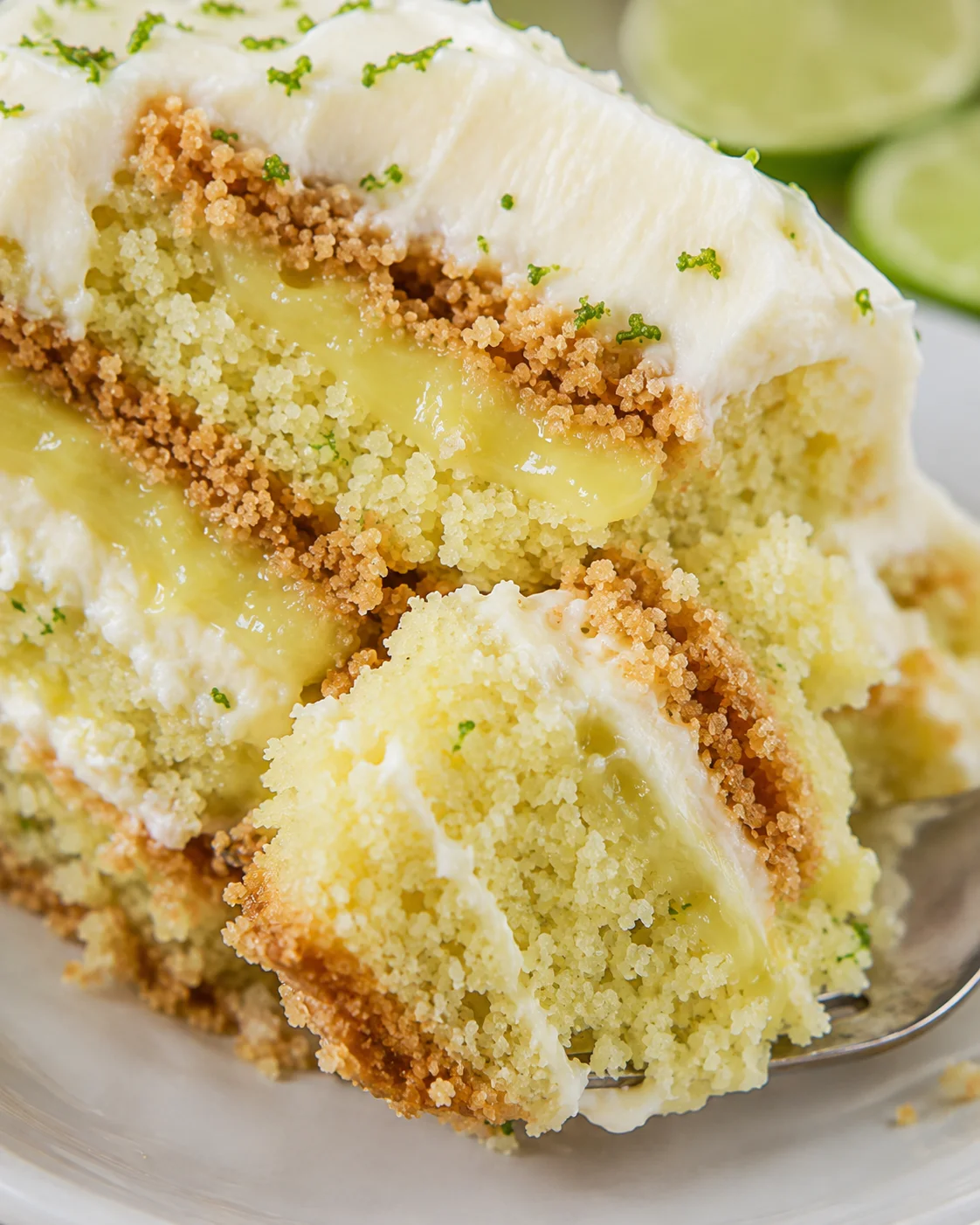
Key Lime Cake brings the bright, tart character of key lime pie into a layered dessert. Three tender vanilla cake layers sit on sweet graham cracker crusts, then get filled with smooth key lime cream cheese frosting and a vivid key lime curd. Lime zest and juice run through the cake, curd, and frosting, so every part of the slice carries a fresh citrus note.
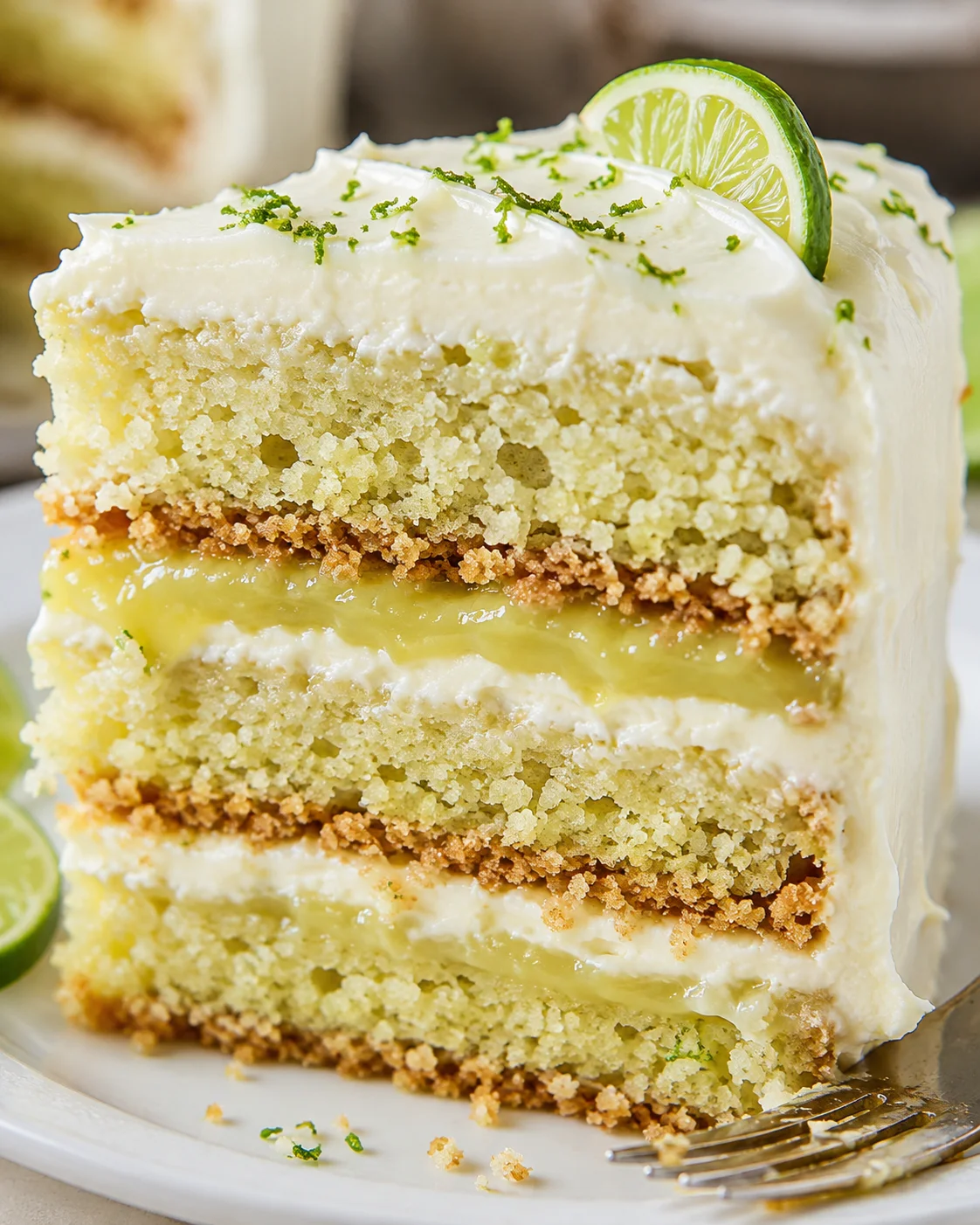
This is a generous celebration cake, yielding about 14–16 servings. The work is divided into manageable parts: bake the crusts and cake layers, make the curd while the layers cool, whip up the frosting, and assemble everything once the components are completely cool. A thin frosting layer keeps the curd from soaking into the cake, while a piped frosting border holds the filling neatly in place.
Plan on about 45 minutes of preparation and 30 minutes of baking, plus cooling, chilling, and decorating time. The finished cake has a soft, moist crumb, a creamy frosting, a tart curd center, and a delicate crunch from the graham cracker layers and crumbs used for decoration.
Why You Will Love This Key Lime Cake
This lime cake recipe is built for anyone who loves the contrast of a buttery cake and sharp citrus. Instead of asking one component to carry all the lime flavor, the recipe uses key lime juice and zest in three places. The cake stays softly vanilla-forward, the curd supplies the concentrated tartness, and the cream cheese frosting adds a smooth, rich layer that balances the filling.
- Graham cracker layers. The crust is pressed into the bottoms of three 8-inch cake pans and baked before the batter goes in. It adds the sweet flavor and texture that make the dessert feel connected to key lime pie.
- A tender reverse-creamed cake. Butter is worked into the dry ingredients before the wet ingredients are added. Coating the flour with fat helps limit gluten formation and gives the layers a soft, close crumb that is sturdy enough to stack and frost.
- Two kinds of lime brightness. Key lime juice brings tartness, while lime zest adds fragrant citrus flavor to the cake, curd, and frosting.
- A contained curd filling. A frosting border is piped around each filled layer, creating a barrier that keeps the curd from running into the cake.
- Make-ahead flexibility. The baked cake layers can be wrapped and frozen for up to 2 months, and the completed cake can also be refrigerated or frozen according to the storage directions below.
The result is a layered cake with a clear dessert identity: graham cracker crunch, soft vanilla cake, creamy frosting, tart curd, and a fresh lime finish. It feels right for a summer gathering, a birthday, or any occasion that calls for a dessert with more citrus lift than a standard vanilla layer cake.
Ingredients
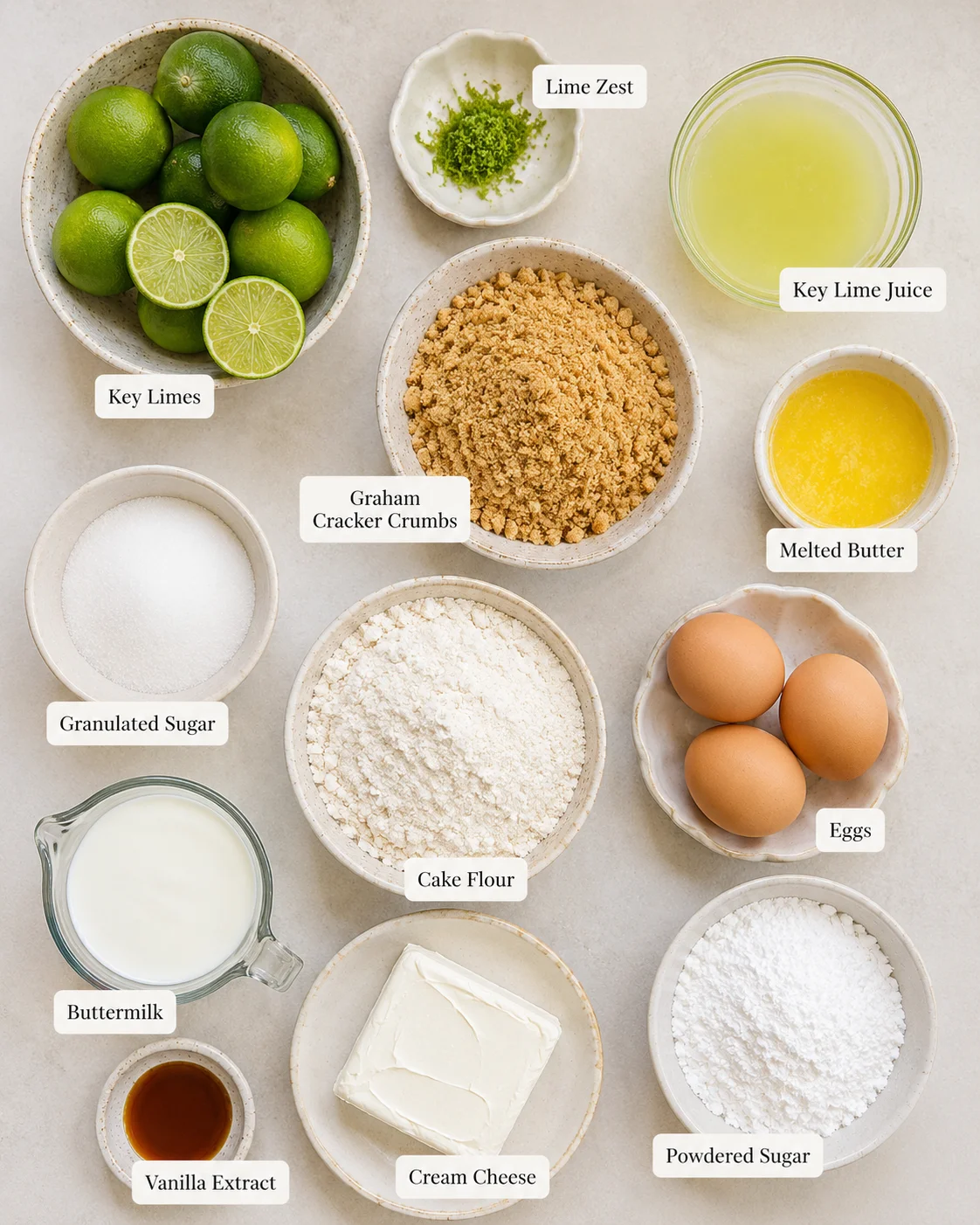
Bring the refrigerated ingredients to room temperature where noted. Room-temperature eggs, buttermilk, and butter blend into the batter more evenly and help the layers bake with less doming. Keep the components grouped as written so the crust, cake, curd, and frosting quantities stay easy to check.
Graham Cracker Crust
- 2 1/2 cups graham cracker crumbs (about 20 full graham cracker sheets), plus extra for decorating
- 1/2 cup salted butter, melted
- 1/3 cup granulated sugar
Layer Batter
- 3 cups cake flour (384g)
- 2 cups granulated sugar (400g)
- 2 1/2 teaspoons baking powder
- 1/2 teaspoon baking soda
- 1 teaspoon salt
- 1/2 cup salted butter, room temperature and cubed (113g)
- 1/2 cup vegetable oil or canola oil (118ml)
- 3 large eggs, room temperature
- 1 1/3 cups buttermilk, room temperature (315ml)
- 2 tablespoons lime zest
- 2 tablespoons key lime juice
- 1 tablespoon pure vanilla extract
Key Lime Curd
- 3/4 cup granulated sugar
- 1/2 cup key lime juice
- 1 tablespoon lime zest
- 4 large egg yolks
- 4 tablespoons salted butter
Frosting and Garnish
- 1 cup salted butter
- 8 ounces full-fat cream cheese
- 6 cups powdered sugar
- 2 tablespoons key lime juice
- 1 tablespoon pure vanilla extract
- 1/2 teaspoon lime zest
- Fresh lime slices, for garnish
Cake flour gives the lightest, softest crumb, but the recipe also works with the same amount of all-purpose flour. The combination of salted butter and oil brings both buttery flavor and moisture. Buttermilk contributes tang, richness, and acidity that works with the baking soda. Full-fat cream cheese gives the frosting its smooth, rich texture.
The graham cracker crumbs are used twice: first as the pressed crust under the cake layers, and again as a decoration on the outside. Reserve the extra crumbs when you measure the crust mixture so you do not have to disturb the finished frosting later. The key lime juice and zest are divided among the cake, curd, and frosting, so measure each portion before you begin. The four egg yolks belong to the curd rather than the cake batter, while the three whole eggs belong to the layers.
Salted butter appears in every component. Use it melted for the crust, softened and cubed for the reverse-creamed batter, cold or softened as needed for the curd, and softened enough to beat smoothly for the frosting. Keeping those jobs separate makes the long ingredient list easier to manage. The same approach applies to the lime: zest before juicing, then divide the zest and juice among the labeled bowls or pans.
How to Make Key Lime Cake
Set out three 8-inch cake pans, parchment paper circles, baking spray or cake release, a mixer, a medium saucepan, a fine mesh strainer, a piping bag with a large open tip, and a cake plate. The cake layers, curd, and frosting all need to be cool enough for assembly, so allow time for those transitions rather than trying to stack warm layers.
- Prepare the pans and oven. Heat the oven to 350°F. Line three 8-inch cake pans with parchment paper circles, then spray them with baking spray or brush them with cake release.
- Make the graham cracker crusts. Combine the graham cracker crumbs, sugar, and melted butter until the crumbs are evenly moistened. Divide the mixture evenly among the pans and press it into flat, even layers with a flat-bottomed cup. Bake for 8 minutes to set the crusts. Remove the pans from the oven and set them aside while you prepare the batter.
- Combine the dry cake ingredients. In a large mixing bowl, whisk together the cake flour, granulated sugar, baking powder, baking soda, and salt. The mixture should be evenly combined before the butter is added.
- Use the reverse-creaming method. With an electric mixer running on low speed, add the room-temperature, cubed butter one tablespoon at a time. Mix each piece in well before adding the next. Continue until all of the butter is incorporated and the mixture looks sandy and dry with coarse crumbs. This gradual step distributes the fat through the flour rather than building a conventional creamed butter base.
- Add the oil and wet ingredients. Mix in the vegetable oil or canola oil on low speed until the flour mixture is evenly moistened. Add the room-temperature eggs, buttermilk, lime zest, key lime juice, and vanilla. Mix, stopping to scrape the bottom and sides of the bowl, until the batter is evenly combined and smooth.
- Fill the pans and bake. Divide the batter evenly between the prepared pans, pouring it over the graham cracker crust layers. Bake for 28–32 minutes, or until a toothpick or skewer inserted into the center of each layer comes out clean with just a few crumbs clinging to it. Do not wait for the tester to be completely dry; a few crumbs are the useful doneness cue here.
- Cool the cake layers. Let the layers cool completely before assembling the cake. If you are working ahead, the baked layers can be wrapped tightly in plastic wrap and frozen for up to 2 months. Thaw them before assembling.
- Make the key lime curd. In a medium saucepan, whisk together the sugar, key lime juice, lime zest, and egg yolks. Add the butter and cook over medium-low heat, whisking or stirring constantly. Continue until the butter has melted and the curd has thickened enough to coat the back of a spoon, about 10–14 minutes. Pour it through a fine mesh strainer to remove bits of cooked egg yolk or larger pieces of zest. Cover the surface directly with plastic wrap and cool completely, or chill it, before using.
- Make the frosting. Beat the butter and cream cheese together in a large mixing bowl until completely smooth and combined. Add the powdered sugar, key lime juice, vanilla, and lime zest. Mix just until the frosting is smooth and combined. It should be light, fluffy, and spreadable; do not overmix, or it can become runny.
- Fill the layers. Level the cake layers with a long serrated knife or cake leveler if needed. Place one layer on a cake plate and spread it with a thin layer of frosting. This first layer helps prevent the curd from soaking into the cake. Transfer 2 cups of frosting to a piping bag fitted with a large open tip. Pipe a border around the top edge of the cake layer to make a barrier for the curd. Spread half of the curd inside the border and smooth it into an even layer. Repeat with the second cake layer, frosting border, and remaining curd.
- Finish the cake. Add the top cake layer and frost the entire cake, reserving enough frosting to pipe swirls around the top edge. A thin crumb coat can be followed by a 20-minute freeze to help the cake set and stabilize while you work with the curd filling. Add the finish coat, then press extra crushed graham cracker crumbs into the frosting about one-third of the way up the cake. Pipe frosting swirls around the top with a Wilton 1M tip or another favorite decorative tip. Finish with fresh lime slices. Freeze the cake for 20 minutes or refrigerate it for 1 hour to set the frosting before slicing and serving.
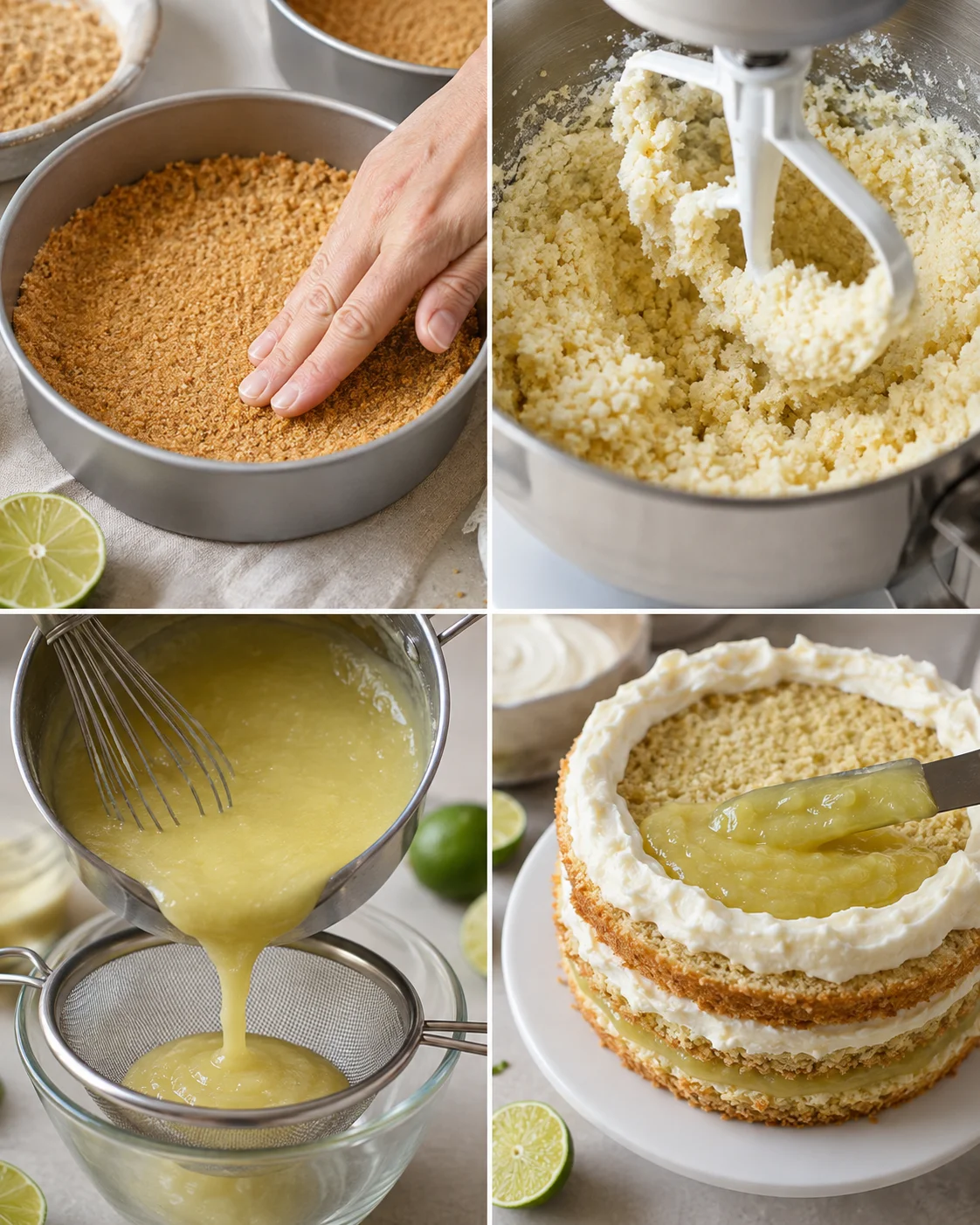
The order matters: cool cake layers are easier to level and stack, a fully cooled curd is less likely to soften the frosting barrier, and a brief freeze or refrigerator rest helps the assembled cake slice neatly. Keep the filling inside the piped borders as you spread it so the layers remain even.
There are several useful visual checkpoints along the way. The crust mixture should look evenly moistened rather than sandy and dry. After the butter is worked into the flour, the batter base should look like coarse crumbs. Once the wet ingredients are incorporated, scrape the bowl so no dry pockets remain underneath. The baked layers are ready when the center tester carries a few crumbs, the curd is thick enough to coat the back of a spoon, and the frosting is light and spreadable without looking loose.
When assembling, place the most level layer on the cake plate first. A thin coat of frosting does two jobs: it gives the curd a smooth surface and keeps the cake from absorbing too much filling. The piped border should be continuous around the edge before the curd is added. Spread the curd gently inside that ring, then place the next layer carefully rather than pressing down hard. That preserves the even layers and leaves room for the finishing frosting.
Tips for Success
- Use room-temperature ingredients. Room-temperature butter, eggs, and buttermilk combine more evenly. The cake layers are less likely to dome as much, and the finished crumb is more moist and tender.
- Add the butter gradually. In the reverse-creaming step, wait 20–30 seconds after each tablespoon of butter is added before adding the next piece. The dry mixture should look sandy with coarse crumbs before the oil and wet ingredients go in.
- Do not overbake the layers. A dry toothpick is not the goal. Check the center with a skewer or toothpick and remove the layers when it comes out clean with a few crumbs clinging to it.
- Strain the curd. Passing the cooked curd through a fine mesh strainer removes any small bits of cooked egg yolk and larger pieces of zest, leaving the filling smooth.
- Keep the frosting light. Mix the frosting only until it is smooth and spreadable. Overmixing can make it runny, which makes the curd barrier and decorative swirls harder to manage.
- Level rounded layers. If the cake layers dome, trim the tops with a long serrated knife or cake leveler before stacking. The scraps can be enjoyed separately, and flat layers make the filling and frosting easier to distribute.
- Build a clear curd barrier. The thin frosting layer under the curd and the piped border work together. Spread the curd only inside the border, then repeat the same arrangement for the next layer.
- Give the finished cake time to set. Freeze it for 20 minutes or refrigerate it for 1 hour before slicing. This helps the frosting settle around the cake and filling.
If the cake is difficult to stack, check the temperature of the components first. Warm layers or soft curd make assembly less controlled. If the tops are rounded, level them before adding filling; if the frosting starts to look loose, stop mixing rather than continuing to beat it. The cake is easier to handle when each layer is fully cool and the curd has had time to cool or chill after straining.
Use the pan dimensions as part of the recipe rather than treating them as a minor detail. Three 8-inch pans create the three-layer format described here, while the alternate pan notes change both the number of layers and the baking time. Whichever pan you choose, check the center with the stated skewer cue instead of relying only on the clock. The same visual and texture signals apply even when the batter is spread into a different shape.
Variations and Substitutions
- Use regular Persian limes. Key limes are smaller and more floral, brighter, and sharper than regular Persian limes, but Persian limes work when key limes or bottled key lime juice are unavailable. Add a little more zest, or use a combination of half lime juice and half lemon juice to echo the complexity of key lime flavor.
- Choose cake flour or all-purpose flour. Cake flour gives the lightest crumb. If needed, replace it with the same amount of all-purpose flour.
- Replace the buttermilk. When buttermilk is not available, use half sour cream and half milk in its place.
- Increase the frosting. The listed frosting amount gives a relatively thin layer with small swirls on top. For a more heavily frosted cake, increase the frosting by 1.5 times or double it.
- Use a different pan size. For 9-inch cake pans, bake for 22–24 minutes. For a 9×13-inch pan, bake for 30 minutes. For a two-layer cake, bake 25–28 minutes in 9-inch pans or 35–38 minutes in 8-inch pans.
- Change the decoration. Keep the graham cracker crumbs pressed about one-third of the way up the cake, pipe the top with a Wilton 1M tip or another decorative tip, and use fresh lime slices for the garnish.
The lime choice changes the character of the finished dessert, while the flour and buttermilk options change the ingredients without changing the basic assembly. For any pan adjustment, use the stated time as a guide and keep the same clean-skewer doneness cue.
Storage, Make-Ahead, and Freezing
Refrigerating the finished cake
Because the frosting contains cream cheese, store the completed cake in the refrigerator for up to 5 days. Bring it to room temperature before serving for the best taste and texture. A cake with cream cheese-based frosting can sit at room temperature for about 2 hours before it needs to be refrigerated.
Freezing cake layers
The cooled cake layers can be made up to 2 months in advance. Wrap them tightly in plastic wrap and freeze them until you are ready to thaw and assemble the cake. Let the layers thaw before leveling and filling them.
Freezing individual slices
The finished cake freezes well for up to 2 months. For easier serving, flash-freeze individual slices, then wrap them in plastic wrap and transfer them to a freezer-safe container. Thaw the slices overnight in the refrigerator, then let them sit at room temperature for 1–2 hours before serving.
Serving Suggestions
Slice the cake after the frosting has had time to set. Each serving can show the layers of graham cracker crust, vanilla cake, frosting, and key lime curd. Finish the top with fresh lime slices and the extra crushed graham cracker crumbs pressed into the frosting about one-third of the way up the sides.
The dessert has the familiar sweet-tart balance of key lime pie, but in a layer-cake format that makes it easy to portion for a gathering. Serve it chilled or allow it to come to room temperature within the storage guidance above so the cake and frosting are easier to appreciate at their intended soft, creamy texture.
For the cleanest presentation, use a sharp knife and wipe the blade between slices. That keeps the tart curd and pale frosting distinct in each piece while preserving the soft crumb.
Frequently Asked Questions
What is the difference between key limes and regular limes?
Key limes are smaller, with thinner skin that can become slightly yellow when fully ripe. Their juice is brighter, sharper, more floral, and more aromatic than the juice of a regular Persian lime, with a delicate sweetness under the tartness. Persian limes are larger and have a smoother, more straightforward citrus flavor with milder acidity. They can be used in this cake when key limes are unavailable; a little extra zest or a half-lime, half-lemon juice combination can add complexity.
Why use the reverse-creaming method?
Reverse creaming works the flour and butter together before the wet ingredients are added. The fat coats the flour, which helps limit gluten formation and creates a tender, close crumb. The layers remain soft but sturdy enough to stack and frost, making the method especially useful for a filled layer cake.
Can I use all-purpose flour instead of cake flour?
Yes. Replace the cake flour with the same amount of all-purpose flour. Cake flour gives the lightest, softest crumb, while the all-purpose option is useful when that is what you have available.
How can I keep the key lime curd from soaking into the cake?
Spread a thin layer of frosting over the cake layer first, then pipe a border of frosting around the top edge. Add the curd only inside that border. Repeat the thin frosting layer and piped border on the second filled layer before adding the remaining curd.
Can I make the cake layers ahead?
Yes. After the layers cool completely, wrap them tightly in plastic wrap and freeze them for up to 2 months. Thaw them before leveling, filling, and frosting. The completed cake can also be refrigerated for up to 5 days or frozen for up to 2 months using the slice-freezing method.
How much frosting should I use?
The listed amount is enough for the thin filling layers, a full finish coat, and small swirls on top. If you want a thicker layer of frosting or larger decorative swirls, increase the frosting by 1.5 times or double it.
Nutrition
Nutrition information per serving: 897 calories, 139g carbohydrates, 8g protein, 36g fat, 18g saturated fat, 6g polyunsaturated fat, 9g monounsaturated fat, 1g trans fat, 106mg cholesterol, 728mg sodium, 138mg potassium, 2g fiber, 107g sugar, 918 IU vitamin A, 0.04mg vitamin C, 140mg calcium, and 1mg iron.
PrintA layered dessert that combines vanilla cake layers on graham cracker crusts, filled with key lime cream cheese frosting and bright key lime curd, delivering a balanced sweet-tart citrus flavor.
- Prep Time: 45 minutes
- Cook Time: 30 minutes
- Total Time: 2 hours (includes cooling, chilling, and decorating)
- Yield: 14-16 servings 1x
- Category: Dessert
Ingredients
- 2 1/2 cups graham cracker crumbs (about 20 full sheets), plus extra for decorating
- 1/2 cup salted butter, melted
- 1/3 cup granulated sugar
- 3 cups cake flour (384g)
- 2 cups granulated sugar (400g)
- 2 1/2 teaspoons baking powder
- 1/2 teaspoon baking soda
- 1 teaspoon salt
- 1/2 cup salted butter, room temperature and cubed (113g)
- 1/2 cup vegetable oil or canola oil (118ml)
- 3 large eggs, room temperature
- 1 1/3 cups buttermilk, room temperature (315ml)
- 2 tablespoons lime zest
- 2 tablespoons key lime juice
- 1 tablespoon pure vanilla extract
- 3/4 cup granulated sugar (for curd)
- 1/2 cup key lime juice (for curd)
- 1 tablespoon lime zest (for curd)
- 4 large egg yolks (for curd)
- 4 tablespoons salted butter (for curd)
- 1 cup salted butter (for frosting)
- 8 ounces full-fat cream cheese (for frosting)
- 6 cups powdered sugar (for frosting)
- 2 tablespoons key lime juice (for frosting)
- 1 tablespoon pure vanilla extract (for frosting)
- 1/2 teaspoon lime zest (for frosting)
- Fresh lime slices, for garnish
Instructions
- Preheat oven to 350°F. Line three 8-inch cake pans with parchment paper and grease.
- Combine graham cracker crumbs, sugar, and melted butter until evenly moistened. Divide mixture evenly between pans, pressing into flat, even layers. Bake 8 minutes to set crusts. Remove and set aside.
- In a large bowl, whisk together cake flour, sugar, baking powder, baking soda, and salt.
- Add cubed room-temperature butter one tablespoon at a time to dry mix, mixing on low speed until mixture looks sandy with coarse crumbs.
- Mix in oil until mixture is evenly moistened. Add eggs, buttermilk, lime zest, key lime juice, and vanilla extract. Mix until smooth, scraping bowl as needed.
- Divide batter evenly over graham cracker crusts in pans. Bake 28-32 minutes, until a skewer inserted in center comes out with a few crumbs clinging. Cool completely.
- Make key lime curd: in saucepan whisk sugar, key lime juice, lime zest, and egg yolks. Add butter and cook over medium-low heat, stirring constantly until thick and coats back of spoon (10-14 mins). Strain curd through fine mesh. Cover surface with plastic wrap; cool completely or chill.
- Make frosting: beat butter and cream cheese until smooth. Add powdered sugar, key lime juice, vanilla, and lime zest. Mix until light, fluffy, and spreadable; do not overmix.
- Level cake layers if domed. Place one layer on cake plate; spread thin layer of frosting to prevent curd soaking. Transfer 2 cups frosting to piping bag; pipe border around top edge. Spread half of curd inside the border. Repeat with second layer.
- Place top layer; frost entire cake, reserving frosting to pipe swirls on top. Press crushed graham cracker crumbs about one-third way up the sides. Pipe swirls on top and decorate with fresh lime slices.
- Freeze cake 20 minutes or refrigerate 1 hour before slicing to set frosting.
Notes
Use room-temperature eggs, buttermilk, and butter for best mixing and baking results., The reverse-creaming method coats the flour in fat, resulting in a tender crumb., Don’t overbake; remove cake when a skewer comes out with a few crumbs., Strain curd to remove cooked egg bits for smooth filling., Frosting should be light and spreadable to effectively contain curd filling., Cake layers and curd must be cool before assembly for best stacking and spreading., Layers can be frozen up to 2 months; thaw before assembling., Finished cake can be refrigerated for up to 5 days or frozen for 2 months., For thicker frosting layers, increase frosting quantity 1.5 to 2 times., Use Persian limes as a substitute for key limes if needed, adjusting zest and juice for flavor.
Nutrition
- Serving Size: 1 slice
- Calories: 897 calories per serving
- Fat: 36g fat per serving
- Carbohydrates: 139g carbohydrates per serving
- Protein: 8g protein per serving